ICOFOM Welcoming Words
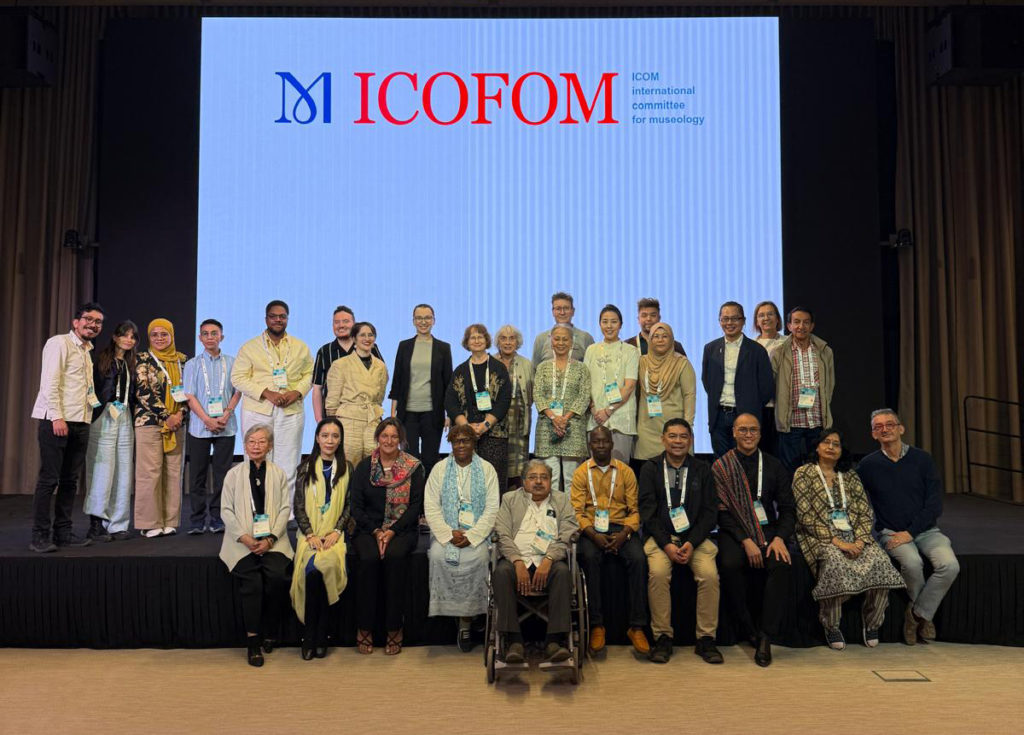
The International Committee for Museology (ICOFOM) is the ICOM committee dedicated to the global study of museology, in both its practical and theoretical aspects. ICOFOM aims to represent and discuss a global vision of museology, through a resolutely inter- and transnational perspective.Our board members include museum professionals from regions spanning North and South America, the Gulf, West Africa, Southeast Asia, and Europe. We bring different areas of expertise, all united by an interest in museology and museological institutions in their many forms.
The actions carried out during this mandate are in line with ICOFOM’s museological heritage since its creation in 1977 but seek to develop new dynamics corresponding to contemporary museological issues. Specifically, we deeply acknowledge and thank the work undertaken by the last three ICOFOM chairs: François Mairesse (2013-2019), Bruno Brulon Soares (2019-2022) and Karen Brown (2022-2025).
The strength of ICOFOM undoubtedly lies in the space it gives to international museological thinking and the decentralized perspectives that this internationalism implies for the development of this discipline. Within this reflection, the space created by the emergence of new museums or new museum forms must take into account the historical and contemporary development of regions such as Latin America, Southeast Asia, the Gulf region, Oceania and Africa. Studying what these new museums represent, for whom they are designed and how they are designed will enable us to initiate a reflection on possible new forms of museology. How do these new museums and museological practices contribute to rethinking the concepts of museums and museology? What dimensions of innovation and experimentation do they operationalise? In keeping with ICOFOM’s long-standing reflections, the issues of translation, multilingualism and vocabulary adaptation will be considered in particular. The dimensions of the circulation and transfer of knowledge, practices, expertise and museological and museum concepts around the world through training and the construction of new museums will be another focus area. Beyond a strict division between centres and peripheries, while keeping in mind the issues of power and persistent asymmetries, the aim will be to question museum and museological norms and standards and their possible adaptations.
Strengthening the links between museums and academic research is also a key issue at a time when many museums are incorporating research institutes dedicated to museology and when museology training courses are multiplying in response to the needs of new museums.Who defines museology today and tomorrow? Encouraging the participation of young museum professionals and young museologists in our committee’s discussions and activities, in particular by actively maintaining grants for annual symposiums and creating dedicated panels, as well as assisting their publication efforts, will be an essential point. As an international ICOM committee connecting members all over the world, we would like to promote new formats for discussions and our committee as a platform that raises voices.
Certain themes addressed in the past will therefore continue to be studied in detail: ecological transition, the decolonisation of museums and museology, social and community museology, issues of power, island museologies, critical museology and the social inscription of museums continue to be key themes for reflection.
Finally, ICOFOM participates in the reflections and actions of ICOM as a whole: the new definition of the museum, its implementation and translation; the drafting of the new Code of Ethics; the establishment of a standing committee for decolonisation. To this end, we wish to work with the entire ICOM community, initiating joint projects with national committees, international committees and regional alliances and pursuing collaborations based on sustainability.